Cataract surgery has made great progress over the years and nowadays involves more than simply removing the cloudy natural lens since it also provides an opportunity to improve the quality and range of a person's vision according to their eye health, lifestyle, and visual needs.
One of the most important decisions when having cataract surgery is choosing an intraocular lens (IOL). Since there are several different types of IOLs on the market, patients frequently ask: Which IOL is the best one to use in cataract surgery?
The answer varies according to several factors, such as the condition of the eye, the degree of astigmatism, the patient's daily activities, their desired amount of independence from spectacles, and the surgeon's evaluation.
At the Renuka Eye Institute in West Bengal the ophthalmologists carefully assess each patient to recommend the kind of IOL that most suits their particular vision needs.
Through this blog we look at the different types of IOL lenses for cataract surgery, the benefits of these lenses, the factors to consider when selecting the appropriate lens, and the significant role that Toric IOLs play in attaining clearer and more comfortable vision.
What Is an IOL?
An intraocular lens, or IOL, is an artificial lens implanted inside the eye during cataract surgery. It replaces the eye's natural lens after the cloudy cataractous lens has been removed. This IOL helps focus light onto the retina and plays an important role in the visual outcome after surgery. Now-a-days, Modern IOLs are available in different optical designs, allowing cataract surgeons to select a lens according to the patient's visual goals.
What Are the Different Types of IOL Lenses for Cataract Surgery?
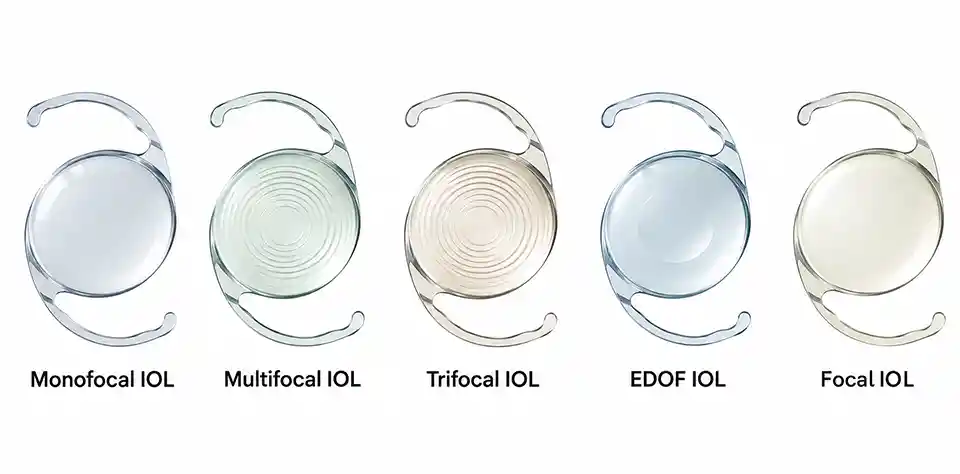
IOLs can broadly be selected according to the type and range of vision they are designed to provide.
-
Monofocal IOLs : A monofocal IOL is designed to provide clear vision primarily at one distance, most commonly distance vision.
They remain a well-established choice for cataract surgery and may be particularly suitable for patients who are comfortable using glasses for reading or other close-up activities.
- Prioritise clear distance vision
- Are comfortable wearing reading glasses
- Prefer a simpler optical design
- Have certain eye conditions that may make presbyopia-correcting lenses less suitable
Monofocal IOLs may be considered for patients who:
-
Enhanced Monofocal IOLs: A Enhanced monofocal lenses are designed to provide a somewhat broader range of functional vision than conventional monofocal lenses, particularly toward intermediate distances.
They may be considered by patients who want good distance vision along with greater visual comfort for activities such as computer use and viewing objects at arm's length.
- Computer work
- Using a mobile phone
- Looking at a dashboard
- Shopping
- Social and outdoor activities
Extended Depth of Focus (EDOF) IOLs: EDOF IOLs are designed to extend the range of functional vision beyond distance vision, particularly toward intermediate distances. They may be suitable for selected patients who want greater freedom from glasses for activities such as:
EDOF lenses can provide an alternative between conventional monofocal lenses and multifocal lenses. However, the suitability of an EDOF IOL depends on the patient's eye health and expectations.
Multifocal or Trifocal IOLs:
Multifocal and trifocal IOLs are designed to provide useful vision at more than one distance, potentially including distance, intermediate and near vision. They can be an option for carefully selected patients who want to reduce their dependence on spectacles. However, these lenses can also be associated with optical phenomena such as halos and glare. Therefore, patient selection and realistic expectations are particularly important. Current cataract-surgery recommendations emphasise considering ocular health, lifestyle and the patient's desire for spectacle independence when evaluating presbyopia-correcting IOLs.
What Are Toric IOL Lenses?
One of the most important IOL options for patients with astigmatism is the toric IOL.
A toric IOL is an intraocular lens specifically designed to correct regular corneal astigmatism during cataract surgery.
Unlike a standard spherical IOL, a toric IOL has different optical powers along different meridians. When the appropriate toric lens is accurately calculated and positioned along the intended axis, it can compensate for corneal astigmatism.
In simple terms, a toric IOL can help address two problems during the same cataract procedure:
Cataract + pre-existing regular corneal astigmatism
This makes toric IOLs an important option for appropriately selected cataract patients.
Why Is Astigmatism Important in Cataract Surgery?
Astigmatism occurs when the cornea has an uneven curvature. Instead of being approximately round like a basketball, an astigmatic cornea has a more elongated curvature.
-
This can contribute to:
- Blurred vision
- Distorted vision
- Reduced visual sharpness
- Difficulty achieving clear distance vision without glasses
What Are the Main Benefits of Toric IOLs?
For appropriately selected patients, toric IOLs can offer several potential advantages.
Correction of Corneal Astigmatism:
The primary purpose of a toric IOL is to reduce the effect of pre-existing regular corneal astigmatism.
Better Uncorrected Distance Vision:
Reducing postoperative astigmatism can improve the likelihood of achieving clearer distance vision without glasses. Evidence summarised by the AAO supports better uncorrected distance visual outcomes with toric IOLs compared with non-toric options in suitable patients.
Reduced Dependence on Distance Glasses:
By addressing the spherical refractive error and astigmatism within the same IOL, toric lenses may reduce the need for distance spectacles.
Available With Different IOL Designs:
Toric technology is not limited to conventional monofocal lenses. Toric versions can also be incorporated into certain presbyopia-correcting designs, including multifocal and EDOF-type lenses.
This means a patient with astigmatism may have more than one IOL strategy available, depending on individual suitability.
Toric IOL vs Standard IOL: What Is the Difference?
The key difference is astigmatism correction.
A standard monofocal IOL primarily corrects the spherical component of refractive error and provides vision at the selected focal distance. A toric IOL additionally contains a cylindrical component designed to address regular corneal astigmatism.Therefore:
Standard IOL: Primarily addresses cataract-related lens opacity and spherical refractive requirements.
Toric IOL: Addresses cataract-related lens opacity while also correcting suitable pre-existing regular corneal astigmatism.
The decision should be based on detailed measurements rather than simply choosing a more advanced lens.
How Do Doctors Choose the Best IOL for Cataract Surgery?
IOL selection involves several factors.
- Eye Health: The surgeon assesses the cornea, retina, optic nerve, macula and other structures of the eye.
- Amount of Astigmatism:The degree and type of astigmatism can influence whether a toric IOL should be considered.
- Lifestyle: Your visual requirements may be different if you:
• Drive frequently
• Use a computer for several hours
• Read extensively
• Spend considerable time outdoors
• Have hobbies requiring detailed vision - Desired Spectacle Independence: Some patients want to minimise glasses as much as possible, while others are comfortable wearing reading glasses.
- Previous Eye Surgery: Patients who have undergone previous corneal refractive procedures such as LASIK or PRK may require specialised IOL calculations and careful planning.
- Ocular Surface Health: Dry eye and an unstable ocular surface can affect the accuracy of preoperative measurements. Optimising the ocular surface before final IOL calculations may therefore be important.
- Realistic Expectations: Understanding what an IOL can and cannot achieve is an essential part of cataract surgery planning.
What Tests Are Done Before Toric IOL Surgery?
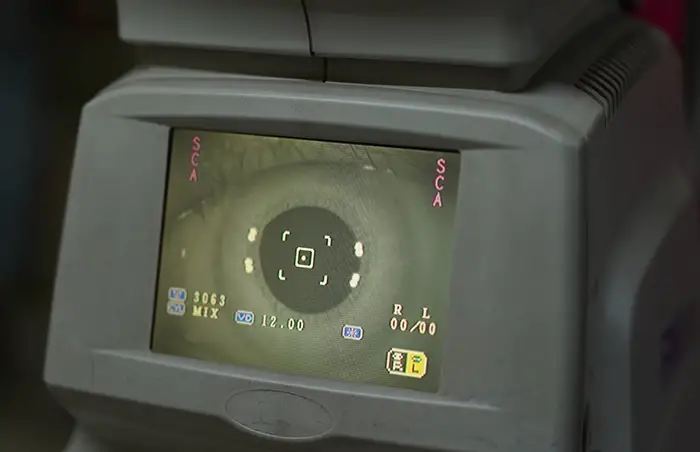
Toric IOL planning requires accurate assessment of the cornea and the eye's optical characteristics. Depending on the individual case, the ophthalmologist may perform:
• Comprehensive eye examination• Optical biometry
• Keratometry
• Corneal topography
• Corneal tomography
• Assessment of corneal astigmatism
• Retinal evaluation
• Additional scans when clinically indicated
The ESCRS recommends incorporating measurements such as posterior corneal astigmatism and effective lens position into modern toric IOL calculations where appropriate.
What Is the Best IOL for Cataract Surgery?
There is no universal answer. The "best" IOL depends on what the patient needs.
| Patient requirement | IOL option that may be considered |
|---|---|
| Primarily wants clear distance vision | Monofocal IOL |
| Wants some additional intermediate range | Enhanced monofocal IOL |
| Wants greater distance-to-intermediate vision | EDOF IOL |
| Wants greater spectacle independence across multiple distances | Multifocal/trifocal IOL |
| Has significant regular corneal astigmatism | Toric IOL |
| Has astigmatism and wants an extended range of vision | Toric EDOF IOL, when suitable |
| Has astigmatism and wants multiple focal distances | Toric multifocal/trifocal IOL, when suitable |
How Do Doctors Choose the Best IOL for Cataract Surgery?
Patients often search online for the "best IOL lens brand for cataract surgery." However, the brand name alone does not determine the quality of the visual outcome. Important considerations include:
- Whether the lens design suits your eye
- Accurate IOL power calculation
- Correct assessment of astigmatism
- Appropriate surgical planning
- Correct toric axis alignment where applicable
- Overall eye health
- Patient expectations

Conclusion
For people with significant regular corneal astigmatism, a toric IOL can be an important option. Its primary role is to correct astigmatism during cataract surgery and potentially improve uncorrected distance vision.
Ultimately, the right IOL is not simply the newest or most expensive lens. It is the lens that is most appropriate for the patient's eyes, lifestyle, visual expectations and overall ocular health.
Choosing the right intraocular lens (IOL) is an important decision when planning cataract surgery. From standard monofocal lenses to advanced options such as toric lenses, the ideal IOL depends on factors such as your eye health, degree of astigmatism, lifestyle, and individual vision requirements. Consulting an experienced cataract surgeon can help you understand the benefits, limitations, and suitability of each lens option before making your decision.
If you are researching cataract operation cost, or the overall cost for cataract surgery in Kolkata, it is important to look beyond the price alone. The type of IOL, surgical technology, diagnostic evaluation, surgeon’s expertise, and individual treatment requirements can all influence the overall cost.
At Renuka Eye Institute, our experienced eye care team provides personalised guidance to help patients understand their cataract treatment and IOL options. If you are considering cataract surgery in Kolkata, schedule a consultation with our cataract specialists to determine which lens design is most appropriate for your visual needs and make an informed decision about your eye health and future vision.